There's More to Tempura in Asakusa Than You Might Think
When you think of Japanese food, tempura is probably one of the first things that comes to mind.
But did you know it has a pretty interesting history in Tokyo?
Back in the Edo period, tempura was popular street food. Vendors would fry up seafood from Edo Bay—shrimp, fish, conger eel, whatever was fresh—and sell it to people looking for something quick and tasty.
And Asakusa? It was one of the liveliest parts of town, packed with people visiting Sensoji Temple or heading out for entertainment.
Even today, Asakusa is a great place to eat tempura.
You've probably heard of some of the big names, like Daikokuya Tempura, Tendon Tenya, or Tendon Akimitsu.
But there are smaller places worth knowing about, too.
I found four that really caught my attention.
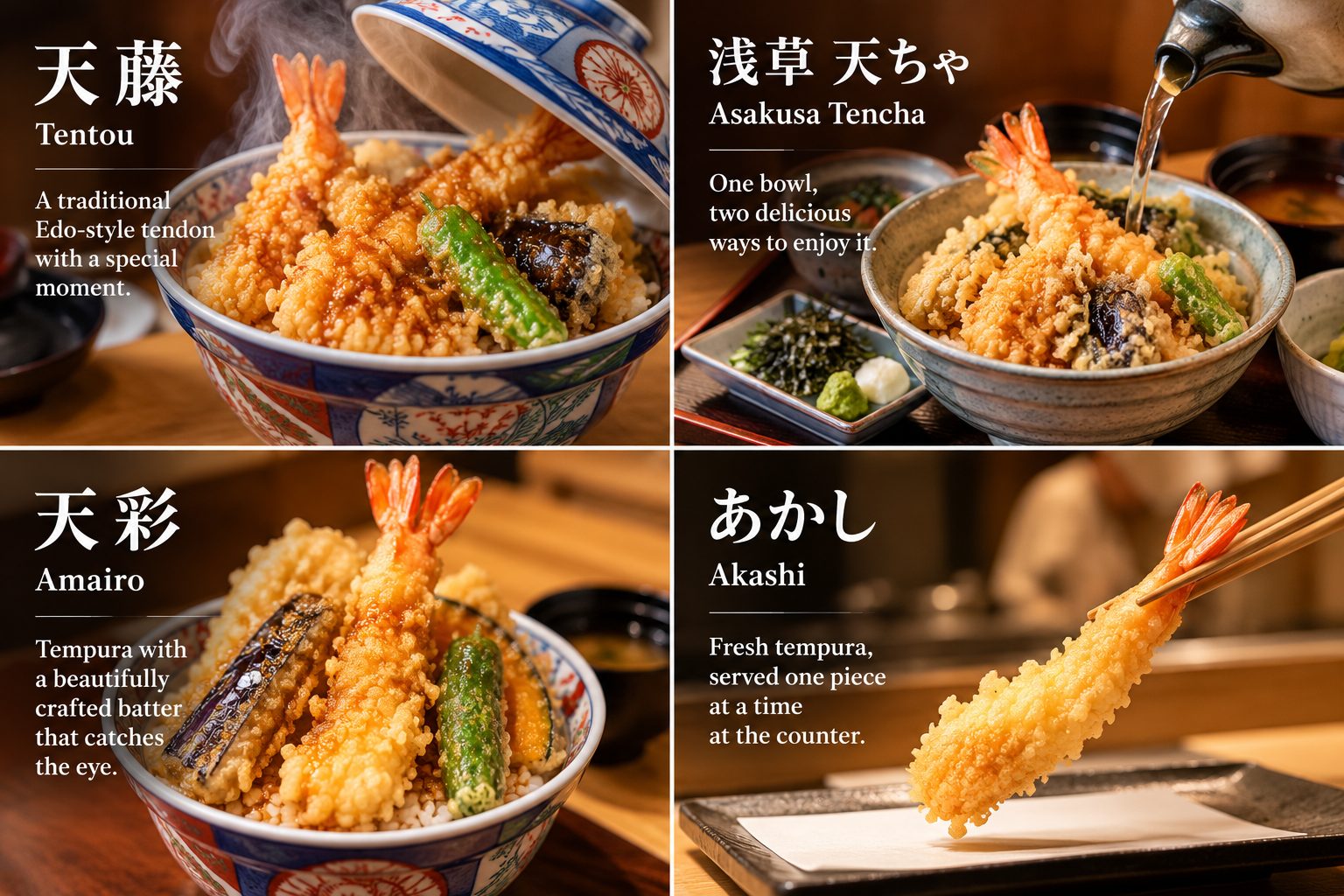
Three serve tendon—tempura on top of rice—but each does it a little differently. The fourth is all about sitting at the counter and enjoying tempura fresh out of the fryer.
And honestly? I want to try every single one.
1. Tentou (天藤) — There's Something Special About Lifting That Lid
Near Hoppy Street, you'll find Tentou, a place serving traditional Edo-style tendon.
Here's one little detail I love.
The tendon comes in a bowl with a lid.
You lift it off, and out comes that warm steam, carrying the smell of tempura and its sweet-savory sauce.
I know. It's just a lid.
But think about it. These days, everything is about speed and convenience. And here's this little tradition that makes you slow down for a second and enjoy what's right in front of you.
I love that.
Another thing that caught my eye is their kakiage tendon.
Kakiage is a mix of ingredients fried together in a light batter. Tentou's version includes kobashira, small adductor muscles from pen shells that add their own delicate sweetness.
If you like seafood, that sounds pretty tempting.
What I'd order: Tendon or kakiage tendon.
2. Asakusa Tencha (浅草 天ちゃ) — One Bowl, Two Completely Different Experiences
This place has a fun twist on the usual tendon.
It's called tendon mabushi.
Here's how it works.
First, you eat the tendon just like you normally would. Tempura, rice, and sauce—the classic combination.
Then, about halfway through, you switch things up.
You pour hot dashi over the rest of the rice and tempura. The broth is made with Hidaka kombu and bonito, and you can add nori and wasabi if you like.
Suddenly, it's almost like a completely different dish.
They also have something called Tencha Gozen, which uses a fragrant yuzu-flavored broth.
What I like about this is how the whole meal changes as you eat.
You start with that rich, satisfying flavor of tempura and sauce, then finish with something lighter and more comforting.
It's a clever idea.
And I'd love to see how those flavors come together.
What I'd order: Scallop and shiba shrimp tendon mabushi set, or Tencha Gozen.
3. Amairo (天彩) — This Tempura Looks Seriously Good
Now, this is one place I'm really curious about.
I've worked as a Japanese chef for over 25 years, and I've fried a lot of tempura in my time.
So when I look at tempura, the first thing I notice is the batter.
Is it too thick? Does it look oily? Can you still tell what's underneath?
I was going through photos of Amairo's food posted by different customers, and something caught my eye.
Even with the tendon sauce poured over it, you can still see all those little details in the batter.
It doesn't look thick or heavy. You can actually make out the shape of the ingredients underneath.
And here's what really impressed me.
I kept seeing the same thing in photos from different customers.
That's a pretty good sign.
See, good tempura isn't just about making something crispy.
When you fry an ingredient, some of its moisture escapes, which can help concentrate its flavor. The batter also protects what's inside.
But if that batter is too thick or soaks up too much oil, you end up tasting more batter than the ingredient itself.
And that's not what you want.
The ingredient should always be the star.
Of course, there's only so much you can tell from photos.
I haven't eaten here, so I can't say for sure how the tempura tastes or how crisp it actually is.
But judging by what I've seen?
From the photos, it looks like the chef really knows what they're doing.
I really, really want to try this place.
What I'd order: Special tendon.
4. Akashi (あかし) — Fresh Tempura, One Piece at a Time
Now, this is a completely different way to enjoy tempura.
At Akashi, you sit at the counter, and the tempura comes out one piece at a time, freshly fried.
Personally, I love this style.
Just imagine sitting there, close to the kitchen.
You hear the sound of the oil. You watch the chef work. Then a piece of tempura is placed in front of you, still hot from the fryer.
That first bite.
The delicate crunch of the batter. The heat. The flavor of the ingredient itself.
That's the kind of experience I look for in a good tempura restaurant.
Akashi reportedly uses fresh sesame oil, which is another detail that caught my attention.
And from the photos and information I've seen, it looks like a place where you can enjoy proper counter-style tempura without paying the kind of prices you might expect at a high-end tempura counter
Now, I haven't actually been there yet, so I can't tell you exactly how good it is.
But it looks promising.
And it's definitely somewhere I'd like to visit.
What I'd order: A tempura course, served one freshly fried piece at a time.
Four Places. Four Different Ways to Enjoy Tempura.
That's what I love about Japanese food.
Even when two places serve the same dish, the experience can be completely different.
At Tentou, there's that little moment when you lift the lid and smell the steam.
At Tencha, you get to enjoy one bowl in two different ways.
At Amairo, it's the frying technique that has me curious.
And at Akashi, it's all about enjoying each piece the moment it comes out of the fryer.
Same basic idea. Four completely different experiences.
So, which one would I choose?
Honestly, I want to try all four!
Got Questions About These Places?
Maybe you're thinking about visiting one of these restaurants but need a little more information.
Things like:
- What time do they open, and which days are they closed?
- Do they take credit cards?
- Do I need a reservation? And how do I make one?
- Do they have an English menu?
- What should I order?
Tell me which restaurant you're interested in and what you'd like to know. I'll check what I can and get back to you with information I can verify.